

How Can Subcontractors Solve Chronic Crew Shortages on Mission-Critical Projects?
Chronic crew shortages don't have to mean a schedule crisis. See how a Vendor Management System paired with a Managed Service Provider gives subcontractors real-time visibility into qualified labor, before a staffing gap turns into a missed milestone.

The Mission-Critical Labor Shortage Isn't a Headcount Problem. It's a Sequencing Problem.
The construction labor shortage gets framed as a headcount problem. On mission-critical builds, the trade most likely to blow the schedule is often the one with the fewest people: commissioning agents and testers holding up hundreds of person-months of work. Here's why that's a visibility problem, not just a supply one, and what a VMS and MSP program can do about it now.
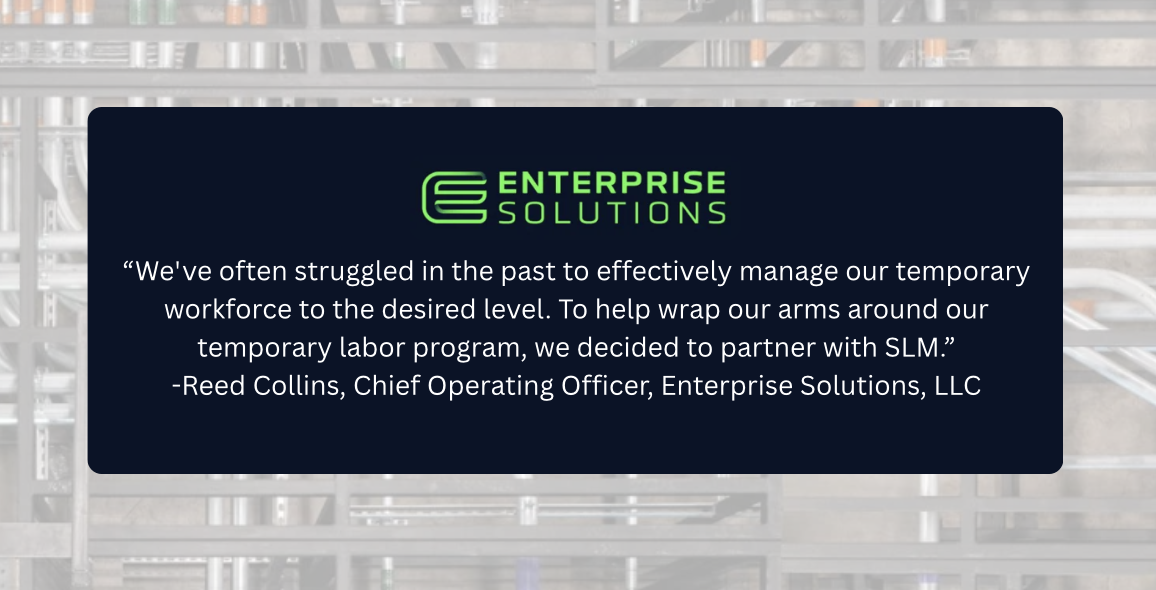
How Enterprise Solutions Took Control of Labor Risk, Productivity, and Cost with SLM
Enterprise Solutions, LLC didn't have to fire a single staffing agency to fix its temp labor problem. By partnering with SLM instead of managing agencies one by one, the company replaced its fragmented, agency-by-agency approach with one system, gaining real-time productivity visibility, standardized rates across every vendor, and a measurable drop in labor risk.
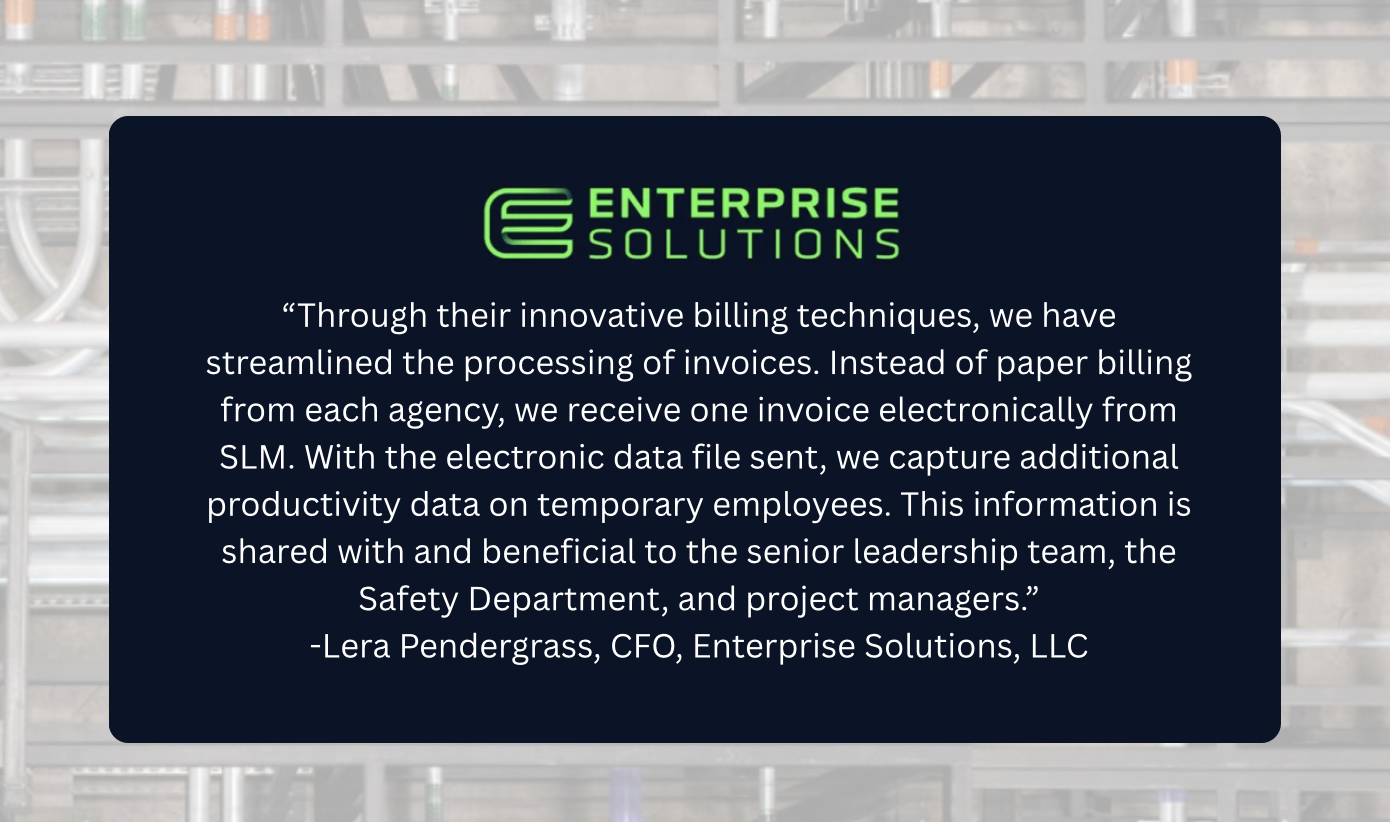
How Enterprise Solutions Cut Temporary Labor Costs and Reclaimed Two Days a Week with SLM
Enterprise Solutions, LLC was managing up to ten different staffing agencies, and its accounting team was losing nearly two full days a week just processing invoices. By centralizing the temporary workforce management through Smart Labor Management (SLM), the company consolidated multiple paper invoices into a single electronic invoice, gained real-time labor cost and productivity data, and freed up significant finance-team time, all while keeping its existing staffing agency relationships intact.
Recore Electric Partners with Smart Labor Management to Gain Full Visibility Into Labor Spend While Scaling Fast
As one of the largest electrical contractors in the Charlotte Metro Area, Recore Electric is scaling fast, and leadership wanted the infrastructure to match that growth. That's why Recore partnered with Smart Labor Management, bringing in a consolidated labor platform to support expansion across commercial and industrial projects. The results speak for themselves: invoice volume dropped 97%, from 30-40 invoices a week down to one per job, and the team freed up as much as 832 administrative hours a year. With one dashboard for labor spend, compliance, and workforce data, Recore's supervisors now have the real-time visibility to manage staffing with confidence, and the bandwidth to keep pushing growth forward.

MSP vs. VMS: You're Probably Using These Terms Wrong (Everyone Does)
"MSP" and "VMS" get used all the time interchangeably, but they're not the same thing, and confusing them can lead you to buy the wrong solution. A VMS is software: the system of record for timesheets, compliance, and invoicing. An MSP is a service: the team running your labor program. Here's how to tell which one you need or whether you need both.

You Don't Need to Fire Your Staffing Agency. You Need a Better Way to Manage Them.
Adding more staffing agencies solves your coverage problem, but it can quietly create a new one: more invoices, more compliance paperwork, more people to chase. This post breaks down what actually changes (and what doesn't) when you add a coordination layer like SLM on top of the agency relationships you already have, plus a side-by-side comparison of managing one agency, many agencies with no system, and many agencies with SLM.
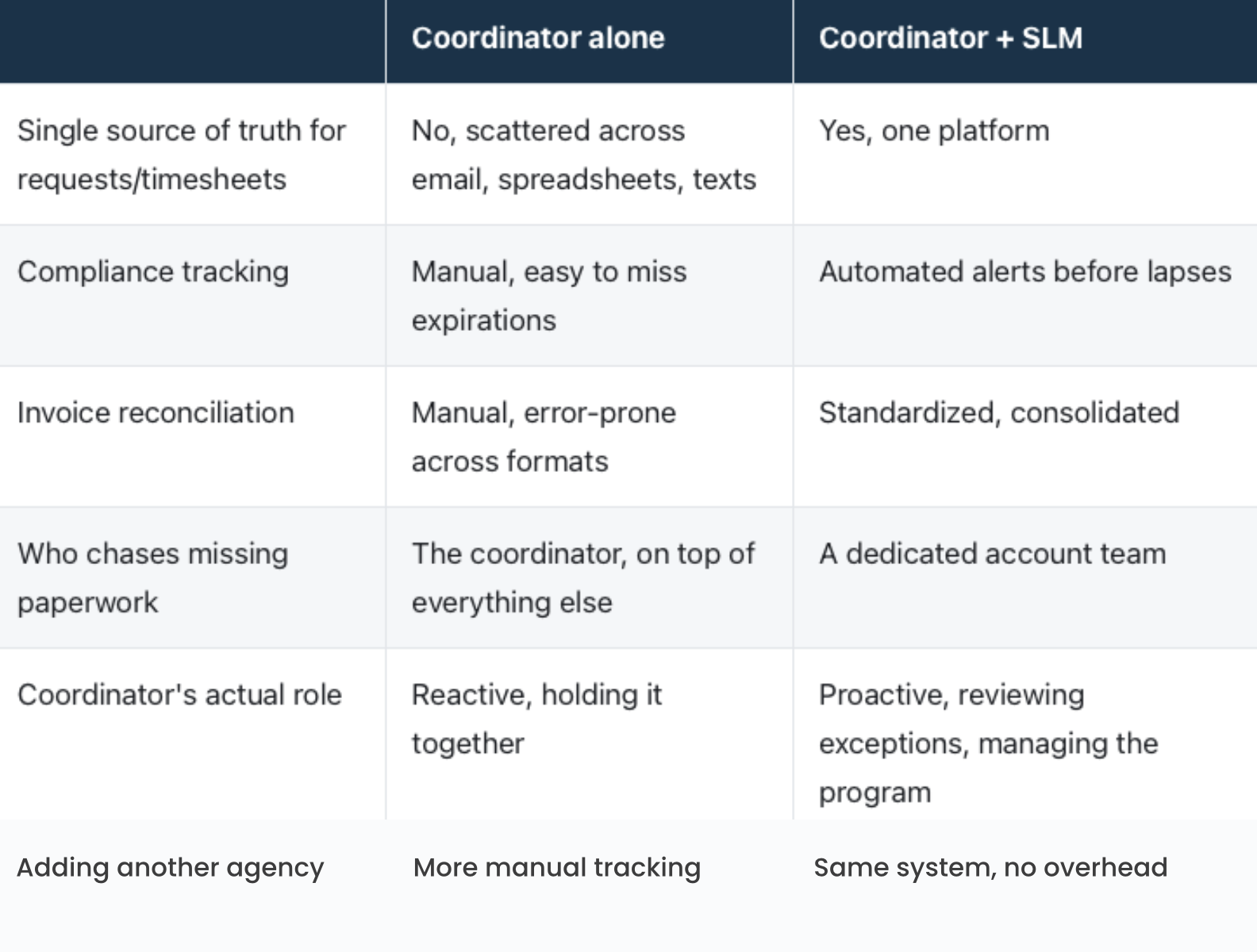
Your Best Labor Coordinator Is About to Burn Out. Here's Why That's Not Their Fault.
Your labor coordinator isn't bad at their job. They're doing an impossible one. As supplier count and site count grow, spreadsheets and manual tracking stop being enough, and the instinct to hire another coordinator only doubles the coordination problem instead of solving it. Here's why the real fix is a system, not more headcount.

Why Do Data Center Contractors in Texas, Georgia, and Virginia Need an MSP/VMS Staffing Solution?
Where do I find skilled labor for data center construction? It is one of the most searched questions among contractors in Texas, Georgia, and Virginia right now. Labor, not funding or land, has become the biggest constraint on the data center boom. Here is why GCs and subs need an MSP and VMS working together as a single command center for contingent workforce management.

The Gigawatt Era: Inside the 5 Largest Data Center Projects in America in 2026 and the Contractors Pouring the Concrete
A 100-megawatt data center used to be considered massive. Now developers are building gigawatt-scale campuses that cost tens of billions and demand tens of thousands of tradespeople. Here's an inside look at the five largest U.S. data center projects underway in 2026, who's building them, what makes each one uniquely complicated, and why skilled labor has become the real bottleneck.

Data Center Boom 2026: Why Are Texas, Virginia, and Georgia Leading the U.S. Market?
Texas and Virginia are the only states with over 100 data centers under construction and Georgia's pipeline is growing five times faster than its current footprint. Here is what is really driving the AI-fueled data center race in these three states, and why power, not just land or fiber, is becoming the deciding factor.

The Jobsite Your Competitors Can't Staff
The biggest construction boom in a generation is landing in rural counties in Virginia, Texas, Iowa, and Arizona, and the contractors winning that work aren't figuring out the labor market after the contract is signed. They have the supplier network, the market intelligence, and the infrastructure in place before the bid goes out. On projects bid without local labor-market intelligence, actual labor costs routinely run 12–20% over the estimate. Here's how leading contractors close that gap.

From Phone Calls to a Platform: How Contractor–Supplier Accountability Has Changed
The best supplier relationships in industrial construction have always run on a simple principle: trust, but verify. The trust was never the problem—the verify was, because for most of the industry's history there was no standardized, visible way to do it. As programs grew across regions and compliance requirements multiplied, ops directors found themselves short not on trust, but on the shared data to back it up. That's the gap SLM was built to close—not to replace the relationship layer, but to finally give it the verify side it's always needed.

5 Signs Your Temp Labor Operations Are Quietly Costing You More Than You Think
Most of the time, the expensive problems in construction ops aren't the obvious ones. They're the costs that are real, recurring, and completely invisible until someone decides to go looking.
Temp labor operations are one of the biggest sources of invisible cost in non-union industrial construction — not because contractors are making bad decisions, but because the systems most teams use to manage contingent labor were never designed to surface what they're spending. Here are five signs your temp labor program is quietly costing you more than it should.

From Uncertainty to Scalability: How DP Electric Tripled Its Hirable Workforce
For DP Electric, growth wasn't limited by ambition — it was limited by workforce predictability. Despite being a high-performing electrical contractor with real market opportunity, the company found itself stuck in a costly cycle: investing heavily in onboarding only to see 75–80% of temporary workers fail to meet hiring standards. Scheduling suffered. Productivity fluctuated. And with little visibility into compliance status or staffing agency performance, scaling into new regions felt like a gamble rather than a strategy.
That changed when DP Electric partnered with Smart Labor Management (SLM) to rethink its approach from the ground up — and the results speak for themselves.

The Hidden Cost of Self-Performing Work: Why Labor Management Is the Biggest Challenge for General Contractors
For general contractors who self-perform, controlling your own labor is a real competitive advantage — until your crew size stops matching the work in front of you. Too many workers and you're bleeding overhead. Too few and schedules slip. And when you need a specialty trade worker who isn't on your payroll, every day spent searching is a day the project falls behind. Here's how the most profitable self-performing GCs are solving it.

Building Smarter: Why the Future of Construction Hiring Is Flexible, and Why That’s a Good Thing
The skilled trades gap isn't going away on its own — and specialty contractors who are waiting on traditional hiring to solve it are falling behind. With more than 501,000 open construction jobs and 41 percent of the craft workforce set to retire by 2031, the math simply doesn't work in favor of the old model. The contractors who are figuring it out aren't hiring harder. They're building smarter workforce strategies — ones built around flexible, contingent labor as a foundation, not a fallback. In a project-based industry where workloads surge, shift, and wind down, a managed contingent workforce isn't a compromise. It's the right answer.

Workforce Fluidity in Construction: How MSP and Vendor Management Are Shaping the Future of Work
Today, the industry is finally upgrading its navigation system. Workforce fluidity is transforming how labor is managed—shifting from rigid, one-dimensional planning to real-time, data-driven coordination. Powered by Managed Service Providers (MSPs) and modern vendor management strategies, contractors can now scale teams with precision, maintain compliance with confidence, and adapt instantly to shifting project demands. In an industry defined by labor shortages, growing complexity, and constant pressure to deliver faster, this shift isn’t just an improvement—it’s a competitive advantage.

Labor Hoarding in Construction: A Smarter Workforce Management Strategy for the Future of Work
As the construction industry faces ongoing skilled labor shortages, a new strategy is gaining traction: labor hoarding. Instead of laying off workers during slow periods, companies are choosing to retain their workforce, protecting institutional knowledge, reducing hiring costs, and improving project continuity. But labor hoarding alone isn’t enough. When paired with smarter workforce management and data-driven planning, it becomes a powerful approach to building resilience and staying competitive in an evolving industry.

The Invisible Workforce: Why Live Data Is the Missing Link in Construction Workforce Management
The construction industry isn’t just struggling to find workers—it’s struggling to see them. Across jobsites, labor moves constantly between tasks, contractors, and phases, yet many project leaders are still making decisions based on delayed or incomplete information. This “invisible workforce” creates costly blind spots, impacting productivity, compliance, and timelines. Live workforce data is emerging as the missing link, giving construction leaders the real-time visibility they need to move from reactive problem-solving to proactive, strategic workforce management.